Moscow June 15, 2013

I’m nicely settled in at my digs on Kutuzovsky Prospect. It’s a large room in anapartment, although my host isn’t around very much so I have pretty much the run of the place. I have a balcony that looks out onto a small park. Cottonwood seeds are floating  around everywhere in the city like a light snow although the temperatures are in the high 70s and it has been sunny. I was dismayed to find out almost immediately that the authorities have blocked accessto all WordPress subdomains, where my blog resides. Apparently a couple of months back they discovered that some terrorist groups were using WordPress, although blocking everyone’s access is an incredibly clumsy way to deal with the problem. In the meantime, I’m sending my posts in a Word file and asking Ben to upload them for me.

Thursday, June 13

I decided to ease into the city by taking in some locations associated with Levitan and Chekhov. But first off I went to the Lenin Library (the Russian State Library) to get myreader’s card. It’s amazing to think that I first worked in that library during a bleak winter some 36 years ago! Then I went to find the School of Painting, Sculpture and Architecture, where Levitan started his arts education in 1873 at age 13. There is a plaque dedicated to the painter Alexei Savrasov on the façade of the building. Savrasov taught at the school and was Levitan’s mentor, but still I found it ironic since Savrasov was fired from the school for drunkenness. Across from the school I noticed that the Theatre Et Cetera was performing a dramatization of Chekhov’s long story “Драма на охоте,” usually translated as “The Shooting Party.” I bought a ticket to see it on Sunday night. For lunch I stopped at a café and had пирожки с мясом and some tea. What a treat to have all the Russian comfort food I want !From there I hopped on the Metro and went to the Novodevichy Cemetery where both Chekhov and Levitan are buried—only three rows away from each other.

Friday, June 14

viewer (1) viewer (3) viewer (5) viewerBefore I left the U.S., this day had been reserved for going to RGALI (the Russian State Archive of Literature and Art) to begin working. The staff had already set aside the documents that I wanted to look at in microfilm form. Again the registration process was very straightforward—I had come armed with the necessary official letter from the Slavic Department at the University of Washington. In going between the archive’s two buildings I managed to forget my “мышка,” my computer mouse at one of them and had  to go back to retrieve it. The archive facilities themselves are very old, very modest. I noticed that there was a high demand on the microfilm readers, so I decided to skip lunch so I wouldn’t lose my spot, working from 10:30am to 4pm. I was starved and exhausted  by the end of the day. I’ll go back on Monday to finish going through the microfilm and hopefully order electronic copies of a few documents. As I expected, Levitan had terrible, almost illegible handwriting, so I want to bring copies of the few missing letters I’ve found back to the U.S. and have someone help transcribe them for me. On Tuesday I’m scheduled to start looking at the original documents that I’ve requested access to. For me, this is exciting stuff!

Posted in Uncategorized | Leave a comment

Blog Access Blocked in Russia

While starting my work in the archives has gone very smoothly, it was a shock to discover that I couldn’t access my blog because many Russian internet providers have blocked all subdomains of WordPress “by a decision of the organs of government authority.” The explanation was that some terrorist groups had been using WordPress. As one Russian blogger commented that’s like going to the doctor with an infected finger and having it treated by cutting your arm off. My workaround will be to send my postings to my son in the U.S. and having him upload the content.

Posted in Uncategorized | 1 Comment

State Archive of Literature & Art

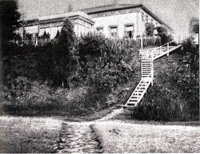
Levitan's studio in Moscow adjacent to the home of his patron Sergei Morozov. He lived and worked here for 11 years.

Levitan’s studio in Moscow adjacent to the home of his patron Sergei Morozov. He lived and worked here for 11 years.

After a series of e-mail exchanges, the staff of RGALI (the Russian State Archive of Literature and Art) has let me know that the documents I’ve requested are being set aside for me and will be available when I make my first visit on June 14th. Here are some examples of what I will be looking at and their significance:

“The Moscow Expulsion 1891-1892. Impressions, Memoirs” by the physician and social commentator Solomon Vermel. Levitan, as a Jew without permanent resident status, was expelled from the city in the fall of 1892. He was allowed to return to Moscow temporarily in December through the intercession of Dmitri Kuvshinnikov, a police physician whose wife Sophia had been having an open affair with Levitan for years. Levitan was understandably reluctant to say much about his expulsion (he had previously been expelled in 1879). Vermel was an acquaintance of Levitan and his family, and wrote one of the earliest monographs on Levitan, which will be available in State Library.

 Unpublished correspondence among those within Chekhov’s and Levitan’s common circle of friends. Here I will be searching for references to the two artists in the hopes of being able to flesh out the nature of their relationship with each other and with their common friends. The correspondents include Tatiana Shchepkina-Kupernik, Lidia (Lika) Mizinova, Maria Chekhova, Franz Shekhtel, and Lidia Yavorskaya, all of whom play major roles in Antosha and Levitasha.

Sophia Kuvshinnikova’s album and diary notes. Those who attended Kuvshinnikova’s soirees, which included Levitan and the Chekhov siblings, were encouraged to write and draw in her album. It contains sketches by Levitan and Kuvshinnikova, and verse by Shchepkina-Kupernik and Yavorskaya. The album is a talisman that I hope will help me bring that world back to life.

 On to Moscow! В Москву!

Posted in Archives, Circle of Friends, Jewish Themes | Tagged , | 1 Comment

Levitan’s Women

Elena Karzinkina

Elena Karzinkina

With my departure for Moscow less than two weeks away, I’m finishing up translating all of Levitan’s published letters to ensure that I don’t overlook anything that should be followed up from sources in the Russian State Library or archives. The only surprise has been the letters Levitan wrote to Elena Karzinkina from 1896 to 1899. Nine years younger than Levitan, Karzinkina was a painter who enrolled in the Moscow School of Art after Levitan had graduated. From Levitan’s letters, it is clear that he was in love with her, although in 1898 she married Nikolai Teleshov, a writer who was the host of a very influential Moscow literary circle.

Many memoirists, when they wrote about Levitan, invariably mentioned that he was a notorious womanizer. In reality, we know the names of only a few women he pursued or was involved with: Chekhov’s sister Maria; Sophia Kuvshinnikova, the married painter and saloniste with whom Levitan openly had an affair from 1890 until 1894; Lika Mizinova, who may have flirted with Levitan primarily to annoy the man she was really in love with: Chekhov; Anna Turchaninova, the wife of a Petersburg official for whom Levitan left Kuvshinnikova; and Elena Karzinkina. It’s likely that we would have learned many other names had not all of Levitan’s letters been burned upon his death.

Levitan’s letters to Karzinkina are the only sustained monologue we have directed at one of the objects of his affections. The letters were polite and respectful of her intelligence, asking her opinions about books they had both read and inviting her to give her impressions of art exhibits she had seen in Russia and Paris. He wrote to her about his bouts of depression and his sense of the futility of life. He called her a heartless creature for failing to write back. He was open about his feelings for her: “Have I really in my old age fallen in love, again, and so hopelessly, since you are such a horrible person!” He confided in her that Chekhov had told him about his worsening tuberculosis: “How distressing it was for me to learn this. I love him.”

Posted in Archives, Circle of Friends | Tagged , | Leave a comment

Levitan Proposes

Maria Chekhova

Maria Chekhova

With a household full of Chekhov siblings and their guests, all spirited, intelligent men and women in their 20s, the atmosphere at Babkino in the summer of 1886 was both lively and emotionally charged. One day Maria Chekhova was walking along the road leading from the estate towards the woods when she unexpectedly met Levitan. They were chatting for a bit when Levitan suddenly dropped to his knees and declared his love for her. Embarrassed, Maria could think of nothing to say, covered her face with her hands, turned around, and ran off back to the house. She stayed in her room all day, crying. As usual Levitan came to the house for dinner, but Maria didn’t leave her room. When Chekhov asked why Maria wasn’t at the table, his brother Mikhail mentioned that he had seen her crying earlier in the day. Chekhov got up and went to her room. Maria told him what had happened and admitted that she didn’t know what to say to Levitan. Chekhov responded, “Of course, you can, if you want, marry him, but keep in mind that he needs women of Balzac’s age, not those like you.” Maria was 23 years old.

Maria recalled that she wasn’t sure what exactly her brother meant, “but felt he was warning me about something.” Chekhov was alluding to Levitan’s taste for older women who were sexually promiscuous, often adulterous. Maria didn’t say anything to Levitan, who “went about Babkino like a gloomy shadow.” She must have wondered how seriously to take Levitan’s declaration given the fact that it was common knowledge that he was comically prone to falling in love. Mikhail noted that “his affairs went on publicly and were always tumultuous and turbulent. They had all the stupid characteristics of love affairs, even including gunshots. If he found a woman who interested him, he would drop everything to pursue her, sometimes quite literally giving chase, even outside Moscow. He would think nothing of kneeling in front of a woman no matter where he happened to be at the moment, whether in a public park or someone’s house. Some women liked that about him, but some were afraid to be compromised and avoided him, even though they were secretly drawn to him.”

Levitan’s awkward and impulsive declaration to the naïve Maria failed to derail what evolved into a warm, lifelong friendship. The next time he declared himself to her, she jokingly hit him with her shoe. He covered his face with his arms and started crying, but the next day he acted like nothing had happened. Neither Levitan nor Maria ever married, and in her old age she fondly recalled that late in his life when he was already gravely ill, Levitan confessed to her (and not just once), “If I had ever gotten married, it would have been only to you…”

Posted in Babkino, Maria Chekhova | Tagged , , | 3 Comments

The Ridiculous Jew

The main house on the Babkino estate

The main house on the Babkino estate

When Levitan arrived at Babkino at the end of May 1886, the Chekhov clan (Anton, sister Maria, brothers Nikolai and Mikhail, and their mother) was already comfortably settled into their summer routines at the estate. For a month Chekhov had been urging his friend (and Levitan’s classmate) the architect Franz Shekhtel to spend the summer there as well: “It’s wonderful here: the birds are singing, Levitan is dressed up as a Chechen, the grass smells, Nikolai is drinking…There is so much air and expression in nature that it’s impossible to describe it…Every twig shouts out and begs to be drawn by the yid Levitan who’s running a loan office at Babkino.” Chekhov had tacked up a sign on the door of the painter’s chicken coop studio: “Merchant Levitan’s Loan Office.”

Evenings at Babkino were given to playing out silly vaudevilles and pantomimes that created an atmosphere familiar to anyone who has seen Chekhov’s plays. In one such entertainment, Chekhov decided to “put the merchant Levitan on trial with all the legalities of jurisprudence including prosecutors and defense attorneys. He is charged with a) refusing compulsory military service, b) secretly distilling alcohol (Nikolai is apparently drinking at his place, since he’s not allowed to drink anywhere else), c) running a secret loan office, d) immorality and so forth.” Levitan willingly played along with this crude anti-Semitic charade.

Not everyone was oblivious to the fact that there was something callow, if not intentionally cruel, in Chekhov’s casting of Levitan as a ridiculous Jew. Nadezhda Golubova, the sister of the estate’s owner, admitted that she found Chekhov’s jokes at the expense of Levitan “a bit grating” even though the painter ignored them “as if they weren’t talking about him.” Sergei Goloushev, an art critic who was part of Levitan’s circle and became his first biographer, accepted that the painter seemed to take things in stride at Babkino, but he found himself wondering how Levitan’s soul reacted to “the constant ridicule directed at him.” Being forced to inhabit the role of outsider, an alien Jew dependent on patronage by the gentry, an interloper among the Russian intelligentsia no matter how assimilationist his inclinations were—this surely contributed to his periodic bouts of depression.

Posted in Babkino, Jewish Themes | Tagged , , | Leave a comment

Levitan and Russian Impressionism

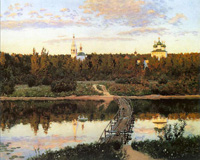
Levitan's "Quiet Abode" (1890)

Levitan’s “Quiet Abode” (1890)

Konstantin Korovin, Levitan’s classmate at the Moscow School of Painting, recalled that their teacher the Itinerant painter Vasily Polenov introduced them to French Impressionism in their landscape class. But Impressionism didn’t make much of an impact on Russian painters in the 1870s and 1880s. It was seen as mostly gimmicky effects and splashy techniques reflecting the superficiality of the French temperament. The dominant Itinerant movement in Russia, even among landscape painters, demanded that art reflect thoughts, feelings, spirituality, if not a political or social philosophy.

One of the first qualities that Chekhov saw in Levitan’s paintings was “truth,” a turning away from romanticized notions of nature toward something more honest. When the writer and family friend Maria Kiselyova criticized Chekhov for showing us a “pile of dung” in one of his early stories, Chekhov responded: “Literature is accepted as an art because it depicts life as it actually is…. Limiting its functions….would be as deadly for art as requiring Levitan to draw a tree without any dirty bark or yellowed leaves.”

But Chekhov also came to recognize that nature in Levitan’s paintings aroused strong emotions in the viewer. In the story “Three Years,” the unhappily married Yulia Sergeevna stands before a painting at an exhibition at the School of Painting that is remarkably similar to Levitan’s “Quiet Abode.” She is emotionally overwhelmed: “…it suddenly seemed to her that she had seen those same clouds that stretched across the red part of the sky, and the forest, and the fields long ago and many times; she felt lonely, and she wanted to walk, walk, walk down the path; and where the sunset’s glow was, there rested the reflection of something unearthly, eternal.” However much Levitan started to use some of the optical techniques seen in French art, it was his steadfast emphasis on trying to evoke the lyrical and the spiritual in nature that stamped his Impressionism as distinctly Russian.

Posted in Impressionism, Konstantin Korovin, Moscow School of Painting | Tagged , , , | Leave a comment

Was Chekhov an Impressionist?

"The Lake. Russia" (1900), Levitan's last great work.

“The Lake. Russia” (1900), Levitan’s last great work.

This is not a question to be answered in a few paragraphs. It is a thread that runs throughout Antosha and Levitasha, especially since Levitan is usually thought of as a Russian Impressionist painter. Associating Chekhov with Impressionism has always been problematic if for no other reason than the fact that literary Impressionism never existed as a school or movement. But that hasn’t prevented scholars from seeing a connection between Chekhov’s style and the techniques of Impressionist painters. In his study Literary Impressionism, Chekhov and James, Peter Stowall defined Impressionism as “subjective objectivism” compared to the “omniscient objectivity” of Realism. Stowall emphasized that at the center of Impressionism is the act of perception: “What is perceived is determined by how it is perceived.” This immediately brings to mind the technique often used by Chekhov in his late stories—everything that unfolds is seen through the eyes of the protagonists even when the story is told in the third person. This is achieved through the frequent use of variations of the phrase: “it seemed to him that…”

Here, I believe, we are touching on an unwavering, fundamental perspective held by the elusive Chekhov. In February 1886, when Dunya Efros called off their engagement, Chekhov confessed his foul mood to his friend Viktor Bilibin: “Everything in the world is false, changeable, approximate and relative.” Six years later, he put almost the same words in the mouth of the landscape painter Ryabovsky (a parody of Levitan) in the story “The Grasshopper.” Ryabovsky has begun to grow tired of his affair with Olga Ivanova (an even more scathing caricature of Levitan’s mistress Sophia Kuvshinnikova): He “felt that he had already dried up and lost his talent, that everything in this world was conditional, relative and stupid, and that it did not make any sense to be involved with this woman.”

And yet this view that “everything is relative” is not exactly how I would choose to connect Chekhov with Levitan and Russian Impressionism. There is a more specific influence to be found in the way Chekhov saw that Levitan was able to paint landscapes that evoked deep human emotions, and Chekhov, in a similar fashion, began to use descriptions of nature in his stories to reflect the moods, even the spiritual state, of his protagonists.

Posted in Impressionism | Tagged , , | Leave a comment

Levitan’s Lost Letters

The first page of a letter that Levitan wrote to the artist Elena Karzinkina in July 1896.

The first page of a letter that Levitan wrote to the artist Elena Karzinkina in July 1896.

After Chekhov died in 1904, his sister Maria set about methodically to retrieve his voluminous correspondence. The 1974-83 Soviet Academy of Sciences Complete Collected Works and Letters of Chekhov contain 4,468 letters, although some were cut by the prudish Maria and the Soviet censors, and a few were considered obscene and left out entirely. Still, Chekhov’s 12 volumes of letters represent one of the richest treasures of 19th century Russian literature.

Levitan’s correspondence had an entirely different fate. The only collection of Levitan’s correspondence, published in 1956, contains 151 letters, 55 of which were written to Chekhov. I’ve been able to find about 26 more letters published online and not included in the 1956 collection. But all letters written to Levitan, including those from Chekhov, no longer exist. Upon his death in 1900 Levitan instructed his brother Adolf to burn his correspondence, and he dutifully carried out Isaac’s request. Presumably Levitan had no desire for a record of a lifetime of romantic entanglements to live on after him.

When Anna Turchaninova, Levitan’s mistress during the last six years of his life, moved to Paris in the 1920’s, she brought with her 200 letters to her from Levitan. A visiting artist by the name of Smelov managed to talk her out of burning the letters, and she gave them to him. But at some point on the eve of World War II, Smelov handed the letters to someone to type out and they were lost. We have only one letter that Levitan wrote to Turchaninova.

Much of my research in Moscow this summer will be devoted to confirming whether there are any Levitan letters in the archives that have not been published or only published in censored form, and to see whether unpublished correspondence among Chekhov’s and Levitan’s friends and family contain any new information about the relationship between the writer and the artist.

Posted in Archives, Maria Chekhova | Tagged , | 8 Comments

Crocodile! Крокодил!

"Crocodile," the Soviet era satirical magazine, was brought back to life in 2005.

“Crocodile,” the Soviet era satirical magazine, was brought back to life in 2005.

The very first morning at Babkino, the country estate where he spent the summer of 1885, Chekhov set out to place one of the fish traps he brought from Moscow carefully tied to the back of a cart. As he was lowering the trap into the Istra River, he heard a voice shout out: “Crocodile!” He looked up and saw Levitan calling out from the other side of the river.

For a moment Chekhov couldn’t be sure whether “Crocodile!” was directed at him or the fish in the river. And I find myself unable to fully explicate the nuances of “Crocodile!” and why Chekhov and Levitan so loved to repeat the word. It must have a peculiar ring to a Russian ear, sounding both silly and ominous. Chekhov and Levitan used the word in various ways, sometimes as an endearment, sometimes as a rebuke. The word had long ago infected the speech of their common Moscow circle, and both men played with it in their correspondence for the rest of their lives. Chekhov wrote his publisher from Babkino that Levitan “exaggerates that all fish are crocodiles and has become friends with Begichev [father of the estate owner] who calls him ‘Leviathan.’ ‘I’m bored when Leviathan’s not around,’ Begichev sighs whenever the crocodile is absent.” Levitan, in turn, once told Chekhov with gentle mockery: “You are such a talented crocodile, but you write such trivial stuff!” Another time Levitan pleaded in vain for Chekhov to come visit him: “It would be an extreme joy to see your crocodile physiognomy here.”

Of course, Crocodile was the name of a Soviet era satirical magazine, which came from the title of a Dostoevsky story (1865) about a civil servant who was swallowed by a crocodile and continued to work quite comfortably inside the belly of the beast. Perhaps the word leaped from Dostoevsky’s comic story into common parlance?

Posted in Circle of Friends | Tagged , | 1 Comment