What Attracted Chekhov to Levitan?

Portrait of Konstantin Korovin by Valentin Serov (1891)

Portrait of Konstantin Korovin by Valentin Serov (1891)

As a medical student grounded in science and the practical world, Chekhov wasn’t by nature enamored of artists. He had the example, close at hand, of his brother Nikolai who squandered his life through dissipation and indifference to his talent. In September 1883 in his regular column “Fragments of Moscow Life” for a Petersburg weekly, Chekhov wrote a sketch about the Moscow School of Painting on the occasion of its 50th anniversary. He chided the school’s students: “They draw, don’t care about sciences, sinfully love to drink schnapps, don’t cut their hair, don’t get any farther in anatomy than the neck bones…in general, they’re nice folks. But they do have a specific feature that distinguishes them from other students: they quickly flower and quickly fade.” Chekhov the satirist chastised the students with too broad a brush and a definite lack of prescience: “Where are Ellert, Ianov, Levitan and tutti quanti? Where are they now?”

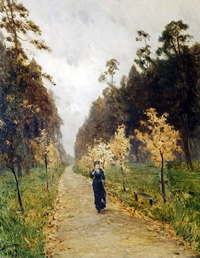
What then attracted Chekhov to Levitan in their student days? Konstantin Korovin’s memoirs, written many years later as impressionistic sketches for emigre newspapers in Paris in the 1930’s, provides some insight. Korovin was Levitan’s classmate at the School of Painting, and the two of them were recognized by both their fellow students and teachers as unusually gifted artists. It was obvious to Korovin that Chekhov and Levitan saw in each other a common work ethic and seriousness of purpose unusual among their bohemian peers. Both found themselves at odds with the prevailing notions of political activism and didacticism. Chekhov’s writing lacked, to use Rosamund Bartlett’s phrase, “any kind of ideological freight.” Levitan’s refusal to even consider making genre paintings expressing an “idea” put him at odds with the dominant aesthetic of the Itinerant movement. One of Levitan’s teachers disdainfully called “Autumn Day. Sokolniki” nothing but “colorful trousers.”

One day Korovin and Levitan were hunting outside of Moscow. They noticed a group of school boys taking an interest in them. Levitan said, “See. They’re looking at us. Because we are hunters! If they knew that we were painters, they wouldn’t want to know us…It’s just the way it is. I’m telling you the truth. We’re not needed. They don’t understand us.” Levitan told Korovin that he could never love a woman who didn’t understand why he felt compelled to paint a gray day or a muddy road: “My sketch, this tone, this blue road, this sadness in a shaft of light beyond the forest. This is me, my spirit. It’s in me. And if she doesn’t feel it, then who are we? Strangers. What will I talk to her about? Antosha understands this.”
Posted in Circle of Friends, Konstantin Korovin, Moscow School of Painting | Tagged , , | 3 Comments

When Did They First Meet?

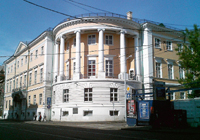
Moscow School of Painting, Sculpture and Architecture, where Levitan and Nikolai Chekhov were fellow students.

Moscow School of Painting, Sculpture and Architecture, where Levitan and Nikolai Chekhov were fellow students.

We don’t precisely know. Chekhov, still in school in Taganrog, visited Moscow for the first time during the Easter holiday in 1877. His older brother Nikolai was already attending the Moscow School of Painting, Sculpture and Architecture, where Levitan was also a student. Without providing any proof, Rayfield conjectures that Levitan and Chekhov may have met during this visit. When Chekhov arrived in Moscow on August 8, 1879 to begin his medical studies at Moscow University, Levitan was living outside of Moscow, forced to leave the city as part of the expulsion of all Jews following the failed attempt to assassinate Alexander II. By the end of September, Levitan was allowed to return to Moscow.

"Autumn Day. Sokolniki" (1879). Nikolai Chekhov added the woman to Levitan's painting.

“Autumn Day. Sokolniki” (1879). Nikolai Chekhov added the woman to Levitan’s painting.

We know that Levitan and Nikolai Chekhov had become friends because that fall Levitan showed Nikolai a painting he was working on: “Autumn Day. Sokolniki,” depicting a wide path gently curving through Sokolniki Park. Nikolai convinced Levitan that the painting was insufficiently expressive–the path was waiting for someone to inhabit it. So Levitan let Nikolai paint in a woman in a black dress walking pensively down the path.

We can presume that Levitan and Chekhov had by then become part of a common circle of students and artists, but the first strong evidence we have that they knew each other is in 1882 when Chekhov and Levitan worked together for several short-lived illustrated magazines. In any case, their friendship grew gradually over several years until the summer of 1885 when Chekhov invited Levitan to stay with him at his dacha at Babkino and paint the surrounding countryside.

Posted in Moscow School of Painting | Leave a comment

Archive Access

RGALI manuscript reading room

RGALI manuscript reading room

Accessing Russian archives appears today to be nothing like the frustrating experience many of us had in Soviet times. I’ve had an email exchange with the Russian State Archives of Literature and Art (RGALI) in which they’ve confirmed the documents I need to present, and reminded me that as a foreign scholar I can also request archival materials two weeks in advance of my arrival, so that they will be available the day I show up. RGALI’s website has a complete list of their holdings down to the level of individual manuscript items. It’s possible to imagine the day in the near future when all the materials will not only be listed, but scanned and available online as well. You won’t even have to leave home!

At RGALI, I will be focusing on unpublished memoirs and letters among the friends and colleagues of Levitan and Chekhov.

Posted in Archives | Leave a comment

Why “Antosha and Levitasha”?

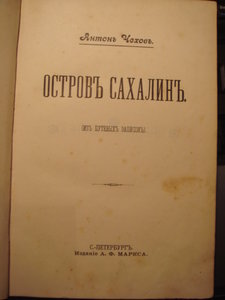
In 1895 Chekhov inscribed a copy of “Sakhalin Island” to Levitan: “I give this book to my dear Levitasha in case he commits a murder out of jealousy and ends up on this island.”

They sound like affectionate nicknames, and they are. Given the formality of salutations in 19th century Russia, the fact that Chekhov and Levitan used these diminutives when writing and talking to each other reveals much about the closeness of their relationship. These nicknames would only be used between people who addressed each other using the informal second-person singular form of “you,” which Chekhov and Levitan only started doing at some point between 1888 and 1890, when they had already known each other for about 10 years. Otherwise, Chekhov did not use the informal “you” with anyone else outside his family until he and the writer Ignaty Potapenko became friends in 1894. And even then, Potapenko said it was hard to feel really close to Chekhov. He was always holding something back “and that is why even the people closest to him felt a certain distance between them and him.” Potapenko concluded that Chekhov really had no friends in the common sense of the term.

Posted in Circle of Friends | Tagged | Leave a comment

Chekhov Uncensored

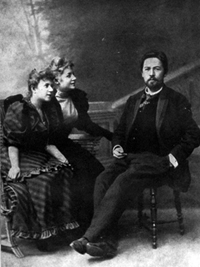
Chekhov with admirers Tatiana Shchepkina-Kupernik and Lidia Yavorskaya. He called the photo "The Temptations of St. Anthony."

Chekhov with admirers Tatiana Shchepkina-Kupernik and Lidia Yavorskaya. He called the photo “The Temptations of St. Anthony.”

Most of Levitan’s and Chekhov’s letters were published in scholarly editions during the Soviet era–Levitan’s in a volume that came out in 1956, Chekhov’s in 13 volumes published between 1973 and 1983. However, in both cases the Soviet censors, acting as strict parents covering their children’s ears, excised the naughty bits, leaving their tracks in the form of brackets: <….>. When Donald Rayfield’s Anton Chekhov: A Life came out, it caused a sensation, especially when it was published in Russia in 2005. With access to the Chekhov archives, Rayfield restored what the censors had cut out. This was not your mother’s Chekhov! It struck some Russians as unseemly that Rayfield’s biography was more about Chekhov’s women than his works. But in the West we are skeptical of biographies that read like hagiographies. It is, in fact, refreshing to have our ears uncovered and be able to hear Chekhov’s real voice. Here below is an excerpt from a letter that Chekhov wrote to his publisher Aleksei Suvorin on 12 June 1894. It was excluded from his collected letters and first made public in 1991 (and, as far as I know, has not been published in English). Certainly, we enjoy its bawdiness. But it also lets us see Chekhov more clearly–his character flaws, his humor, his ability to write an entire short story in ten sentences. It’s the voice of a modern man:

Women who have sex, or as they say in Moscow “do the cockroach,” on every sofa are not just crazy, they’re sick kittens suffering from nymphomania. The sofa is a very uncomfortable piece of furniture. It is blamed for causing fornication a lot more often than it is actually used. I used a sofa only once in my life and swore it off. I have been with loose women and have myself sinned many times, but I don’t believe in Zola and that woman who said, “Bang! Let’s go!” Loose people and writers consider themselves to be gourmets and connoisseurs of fornication. They are bold, decisive and resourceful. They know 33 ways, even doing it on a knife’s edge, but all this is just words, when in fact they are having sex with cooks or going to one-ruble whore houses. All writers lie. Having sex with a lady in a city isn’t as easy as in books. I have never seen a single apartment (of course, of the decent kind) where it would be possible to toss a woman wearing a corset and a skirt in a bustle onto a trunk, a sofa, or onto the floor and have sex with her without having the whole house know about it. All these terms like “doing it standing up” or “sitting down,” etc. are nonsense. The simplest way is in bed, and the 33 other difficult and easy ways are only for a hotel room or a barn. Romancing a lady from proper circles is a long procedure. First, it has to be night. Second, you go to “The Hermitage” hotel. Third, at “The Hermitage” they tell you there are no rooms available, and you go searching for another refuge. Fourth, in the hotel room your lady loses courage, starts shaking and exclaims, “Oh, my God, what am I doing?! No! No!” The right time for undressing and words passes. Fifth, on the way back your lady has an expression on her face as if you had raped her and is constantly mumbling, “No, I will never forgive myself for this!” None of this is at all like “Bang! Let’s go!” Of course, there are times when a person sins and it’s like a shot–Piff! Paff! Let’s go!–but this doesn’t happen so frequently that it’s worth talking about.

Source: Igor’ Sukhikh, Chekhov v zhizni, Moscow, 2010, pp. 245-246

Posted in Archives | 1 Comment

Levitan’s Mother

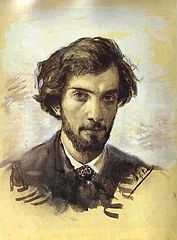
Levitan self-portrait at age 20.

Isaac Levitan self-portrait at age 20.

When you’re writing about people who were born over 150 years ago, they hold secrets that they will never reveal to you. For example, Levitan’s mother died in 1875 when the painter was 15 years old. In fact, she died twice, because we don’t even know her name and she is lost to memory. Chekhov’s sister Maria found it strange that Levitan never talked about his family and his childhood: “It appeared as if he never had a father or mother. At times it seemed to me that he wanted to completely forget about their existence.” Perhaps Levitan simply didn’t want to have to explain how he and his family, as impoverished Jews with no right of permanent residence, came to live in Moscow. But there are other reasons for wanting to know about Levitan’s feelings for his mother. He was an extraordinarily handsome man, a hypersexual manic-depressive. He never married, but had two long-lasting affairs, both with married women who were considerably older than him, relationships which Chekhov, although not a prude, disapproved of.

Readers expect authors to be in command of their subjects. But an author’s mastery is never as unequivocal as he would wish it to be.

Posted in Levitan's Youth | Leave a comment

Famous Friends

I can think of only one other lifelong friendship between a famous writer and a famous painter comparable to that of Chekhov and Levitan–and it happened roughly during the same era. Emile Zola and Paul Cezanne were friends from childhood. When Zola’s novel L’Oeuvre (The Masterpiece), interpreted as an attack on Impressionists and Impressionism, came out in 1885-1886, Cezanne never spoke to him again, which is reminiscent of what happened after Chekhov published “The Grasshopper” in 1892. Ironically, Zola’s earlier art criticism had been so favorable to the Impressionists that the outraged French press refused to publish it, and Turgenev arranged to get in published in Russia in The Messenger of Europe between 1875 and 1879. Levitan was in art school during those years and we don’t know whether he had read any of Zola’s articles, although some of his teachers were surely interested in what was happening in the Paris art world. See Zola, Cezanne and Manet: A Study of L’Oeuvre by Robert J. Neiss, Ann Arbor, 1968.

Posted in Impressionism | Tagged , | 1 Comment