Pavel Chekhov’s Diary

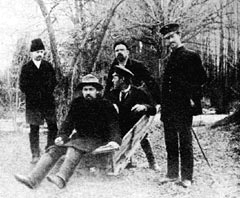
Chekhov's father, Pavel Egorovich, was born a serf.

Chekhov’s father, Pavel Egorovich, was born a serf.

One of the most valuable primary sources from Chekhov’s Melikhovo years (1892-1898) is the diary kept by his father, Pavel Egorovich Chekhov. His children found his laconic, seemingly random entries to be unintentionally hilarious. Here’s a sample: September 7, 1894: “Rain the whole day. They didn’t give Roman the wallpaper at the station. The stove-builders finished the stove in the living room. The horses were in the garden at night.” But actually Pavel Chekhov’s precise listings of who came and went at Melikhovo make it possible to accurately date the sometimes inaccurate accounts in the memoirs of those who visited Chekhov.

Here is Pavel’s diary entry for the momentous day when Tatiana Shchepkina-Kupernik brought Levitan to Melikhovo to be reunited with Chekhov after more than two years of not speaking to each other: January 2, 1895: “It’s snowing, 8 degrees. They brought a stove with pipes for the kitchen. Antosha went to have lunch with the Priest. T.L. Shchepkina-Kupernik and I.I. Levitan arrived after we had already gone to bed.” Shchepkina-Kupernik described the meeting in her memoirs: As they approached the house Chekhov “came out, looking like he had been drinking. He peered into the darkness to see who was with me–there was a brief pause, and suddenly they both flung themselves towards each other, very, very strongly clasped each other’s hand–and…started talking about the most everyday things: about the road, the weather, Moscow, as if nothing had happened. At dinner, when I saw how Levitan’s beautiful eyes were wet and glistening and how Chekhov’s normally pensive eyes were radiating happiness, I was terribly pleased with myself.”

The irrepressible Tatiana Shchepkina-Kupernik was instrumental in both initiating and ending the quarrel between Chekhov and Levitan.

The irrepressible Tatiana Shchepkina-Kupernik was instrumental in both initiating and ending the quarrel between Chekhov and Levitan.

Shchepkina-Kupernik had visited Melikhovo for the first time the previous month. Since Pavel Chekhov was away, the mischievous Shchepkina-Kupernik, obviously with Chekhov’s encouragement, took to adding entries to the diary in his absence, imitating his father’s style: December 4: “Weather is clear. Marinade turned out to be outstanding….” December 5: “Ate wonderful pancakes.”
Posted in Melikhovo, Tatiana Shchepkina-Kupernik | Tagged , , , | Leave a comment

Chekhov’s Restaurants

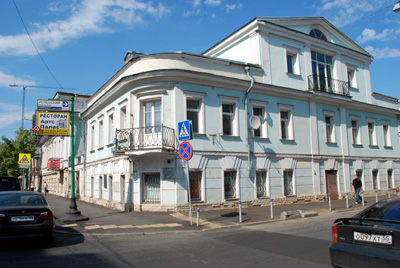
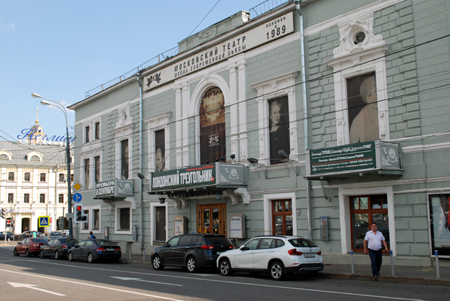
At the end of the 19th century this building housed both the fashionable Hermitage Restaurant and a small theater.

At the end of the 19th century this building housed both the fashionable Hermitage Restaurant and a small theater.

The Hermitage, located on the corner of Petrovsky Boulevard and Neglinnaya Street, was one of Moscow’s most fashionable restaurants and a favorite among Chekhov’s circle of friends. On February 6, 1895 Maria Chekhova found herself having dinner with the writer Dmitri Mamin-Sibiryak at the Hermitage after an impromptu visit to the circus. At the restaurant Mamin-Sibiryak went into a rage when Maria started praising Levitan and dared to call him a “Russian” landscape painter. It was not unusual for critics to disparage Levitan as a Jew incapable of being a truly Russian artist. Maria wrote her brother: “When you come, I’ll tell you everything. He really gave it to me!”

On March 22, 1897 Chekhov met his editor Suvorin for dinner at the Hermitage. Soon after they sat down to to eat, Chekhov began coughing up blood from his right lung. He was taken to Suvorin’s room at the Slavyansky Bazaar Hotel. A doctor was called but Chekhov refused to go to a hospital. Eventually he agreed to be admitted to a private clinic near Novodevichy cemetery. He was discharged on April 10th and told by his doctors that he must move to a warm, southern climate from the fall to the spring.

The Slavyansky Bazaar Restaurant was destroyed in a fire in the 1990s. The building has been restored and turned into commercial space as part of the transformation of Nikolskaya Street into an upscale pedestrian promenade.

The Slavyansky Bazaar Restaurant was destroyed in a fire in the 1990s. The building has been restored and turned into commercial space as part of the transformation of Nikolskaya Street into an upscale pedestrian promenade.

Since Suvorin always stayed at the Slavyansky Bazaar Hotel when he visited from Petersburg, Chekhov often dined with him and their friends at the hotel’s ornate restaurant on Nikolskaya Street not far from Red Square (Chekhov preferred to stay at the Great Moscow Hotel). In the final scene in “The Lady with the Lapdog,”  Gurov comes up to his mistress Anna Sergeevna’s room at the Slavyansky Bazaar. They order tea to be brought to the room:
“…while he was having his tea, she stood there turned toward the window… She wept because she was agitated, because she was bitterly conscious that their life had turned out to be so sad: they could see each other only in secret; they had to hide from people, like thieves! Was not their life ruined?”

Posted in Circle of Friends, Homes and Museums | Tagged , , | Leave a comment

Melikhovo

Chekhov's study at Melikhovo. Prominently displayed on the wall is Levitan's painting of the Istra River at Babkino, which the artist gave to Chekhov.

Chekhov’s study at Melikhovo. Prominently displayed on the wall is Levitan’s painting of the Istra River at Babkino, which the artist gave to Chekhov.

By early 1892 Chekhov had a sufficiently substantial income to finally act on his long-standing desire to buy a country home. In February, on his behalf, his brother Mikhail bought Melikhovo, nearly 600 acres of birch woods and pasture with a small wooden house located 45 miles south of Moscow. Getting there required taking a train as far as the station at Lopasnya (now called Chekhov), then travelling six miles by horse or carriage along a very rough country road.

Chekhov's house at Melikhovo.

Chekhov’s house at Melikhovo.

Chekhov moved there in March, and promptly asked his friends to come stay with him for Easter. Initially Lika Mizinova refused the invitation, causing Chekhov to feign taking offense: “We are nothing to you. We are last year’s starlings whose song has long been forgotten.” When she changed her mind and finally did come, Chekhov didn’t pay particular attention to her, spending most of his days off bird hunting with Levitan.

One evening Levitan wounded a woodcock in the wing. It fell into a puddle. Chekhov lifted it up and noticed its “long nose, large black eyes and beautiful attire. It looked at us with a surprised expression.” Levitan frowned, closed his eyes and asked Chekhov, his voice quivering: “My friend, smash its head with your rifle stock.” Chekhov told him he couldn’t. Levitan continued to nervously shrug his shoulders, shake his head and plead for Chekhov to do it. “In the end,” Chekhov told Suvorin, “I had to do what Levitan asked and I killed it. There was one less beautiful, beloved creature, and the two idiots returned home and sat down to dinner.” This incident stayed in Chekhov’s mind and inspired what would develop into the central image of The Seagull.

In early July 2013, I visited Melikhovo and was given a tour of the estate by Ksenia A. Tchaikovskaya, the chief curator of the museum. In August 2103 New York Times reporter Alison Smale wrote an article about Melikhovo and Ms. Tchaikovskaya, who has worked at Melikhovo for 42 years.

Levitan took this photograph at Melikhovo of Chekhov and his brother Mikhail sitting in a wheelbarrow pushed by Vladimir Gilyarovsky. (Easter 1892)

Levitan took this photograph at Melikhovo of Chekhov and his brother Mikhail sitting in a wheelbarrow pushed by Vladimir Gilyarovsky. (Easter 1892)

Posted in Homes and Museums, Melikhovo | Tagged , , | Leave a comment

Abramtsevo

The manor house at Abramtsevo is being restored.

The manor house at Abramtsevo is being restored.

In early June 1885, Levitan left Chekhov’s dacha at Babkino for Savva Mamontov’s estate at Abramtsevo accompanied by the painter Victor Vasnetsov. The railroad baron Mamontov had turned Abramtsevo, located about 40 miles from Moscow, into an artist’s colony. The previous year Mamontov had started hiring artists rather than decorators to paint the background sets for his new private opera company. Mamontov’s financial generosity and the opportunity to collaborate with his fellow painters had much to do with Levitan’s willingness to do scene painting. But he told Korovin that working on “these enormous canvases made his head hurt and gave him nightmares.” Another former classmate recalled that painting on such a large scale agonized Levitan, given his love of detail.

Abramtsevo studio

Abramtsevo studio

At Abramtsevo, working from Vasnetsov’s sketches, Levitan painted scenes for the upcoming operas A Life for the Tsar and The Snow Maiden. But within two weeks he became seriously ill and returned to Moscow to recover. Unlike Korovin and Vasnetsov, Levitan stopped working for Mamontov by March 1886, when he used his earnings to make his first trip to the Crimea.

Chekhov’s attitude toward Mamontov’s undertaking was derisive. He wrote the following review in his “Fragments of Moscow Life” column following the premiere of The Mermaid in February 1885:

“…now Moscow has a bad Mamontov opera in addition to an unsatisfactory Imperial Opera. Everyone is struck by the new opera, but nothing is more striking than the amount of money squandered on it. The décor is magnificent. The scenery, painted by Vasnetsov, Yanov and Levitan, is splendid; the costumes are of the kind only dreamed of on the Imperial stage; the orchestra is made up of capable musicians very capably conducted; but the male and female singers—heaven help us!”

Posted in Circle of Friends, Homes and Museums | Tagged , , , , | Leave a comment

Levitan Meets Tolstoy

The archives of the Tretyakov Gallery are just down Lavrushinsky Lane from the museum itself.

The archives of the Tretyakov Gallery are just down Lavrushinsky Lane from the museum itself.

Among the unpublished memoirs at the Tretyakov Gallery archive, I came across an interesting anecdote about how Levitan once met Tolstoy, albeit very briefly. In the late 1880’s Levitan was living, on and off, in a furnished room in the low-rent “Anglia” apartments on Tverskaya Street. Across the hall from him lived Alexander Prugavin, a friend of Tolstoy, who would occasionally drop by. Knowing this, Levitan asked Prugavin whether he could come over and meet Tolstoy; he was especially eager to find out what the great writer and wise oracle thought of landscape painting. Prugavin encouraged Levitan to come by, saying that Tolstoy always enjoyed meeting new people.

Sometime later Prugavin and Tolstoy were deep in a conversation when there was a knock at the door. Levitan came in and Prugavin introduced him to Tolstoy, who as usual looked intently at the young artist’s face as they shook hands, then resumed his conversation with Prugavin. Soon afterward Tolstoy said, “Well, I have to go. They’re waiting for me.” As Prugavin showed Tolstoy to the door, he noticed that Levitan looked unusually embarrassed and agitated. After Tolstoy left, Levitan said, “I’m guilty. I scared off Tolstoy. If I hadn’t come, he wouldn’t have left here so quickly.” Prugavin reassured him that Tolstoy had only dropped by on his way somewhere else. Levitan told Prugavin that he was still curious to know what Tolstoy thought of landscape painting and asked him to bring the question up when the opportunity arose.

At some point Prugavin did ask Tolstoy, “What do you think about landscape painting?”

“A landscape?” Tolstoy answered with a question. Shrugging his shoulders, he pronounced: “In my opinion, it’s just background for a picture.” Prugavin was so taken aback by this unexpected, dismissive response that he decided not to tell Levitan what Tolstoy had said about “this form of painting to which he gave all of his soul and made the goal of his life.”

Posted in Archives, Circle of Friends | Tagged , , , | Leave a comment

Korsh’s Private Theatre

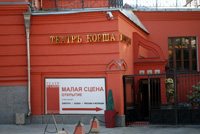
The red neo-Russian style Korsh Theatre on Petrovsky Lane.

The red neo-Russian style Korsh’s Theatre on Petrovsky Lane.

In April 1892 Levitan ran into Chekhov in front of Korsh’s Theatre and demanded an explanation why the writer had caricatured him and his mistress Sophia Kuvshinikova in his story “The Grasshopper.” Chekhov sharply replied that he didn’t owe him any sort of explanation. After this, they did not speak to each other for more than two and half years.

Closeup of Korsh's TheatreLevitan had recently been at Kuvshinikova’s salon where the young Tatiana Shchepkina-Kupernik, who hadn’t even met Chekhov yet, stirred things up by loudly saying to Kuvshinikova and Levitan: “’I don’t understand how Chekhov…It’s all very strange… He’s been at your house, enjoyed your hospitality, was considered a friend and suddenly publishes this disgusting story…How is this possible? It’s totally incomprehensible.” Coincidentally, Shchepkina-Kupernik, taking advantage of the fame of her actor-grandfather, managed to land some minor roles in Korsh’s Theatre the following summer, where she met the actress Lidia Yavorskaya, with whom she carried on a scandalous lesbian affair.

The Moscow businessman Fyodor Korsh founded his private theatre in 1882. It was here that Chekhov successfully staged his first full-length drama Ivanov in November 1887. More typical of the fare at Korsh’s Theatre, which tended toward farces and comedies, was the production of Chekhov’s one-act vaudeville The Bear in 1888.

Thanks again to Rosamund Bartlett’s guide “Literary Russia.”

Posted in Homes and Museums, Uncategorized | Tagged , , | 1 Comment

Along Malaya Dmitrovka Street

In Moscow it’s still possible to imagine what it was like to walk its streets in the late 19th century. Today, I strolled up Malaya Dmitrovka, a street closely associated with Chekhov throughout his life. I used as my guide, Rosamund Bartlett’s Literary Russia.


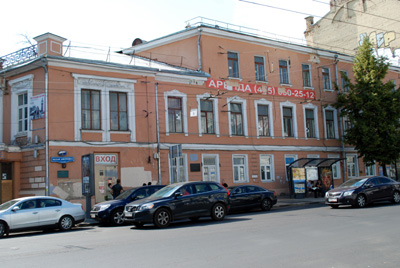
Malaya Dmitrovka Ulitsa 1, editorial offices of "Zritel'"

This three-story building at Malaya Dmitrovka 1 housed the editorial offices of the comic journal The Spectator, to which Anton and Nikolai contributed while still students. The journal’s secretary became Nikolai’s common law wife and together they introduced Anton to what Bartlett calls “the sleazy world of the Moscow dailies.”

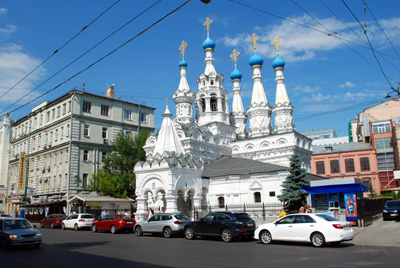
Church of the Natiity of the Virgin in Putinki

Contrasting the sacred with the profane, directly across the street from the offices of The Spectator is the Church of the Virgin, built in the 1650’s.

Malaya Dmitrovka Ulitsa 11

Chekhov lived here at Malaya Dmitrovka 11 for four months in the spring of 1899 while he waited for his house in Yalta to be completed—his doctors had ordered him to move there for his health. He also returned here in the fall prior to spending the winter in Nice. This was a period when he was actively engaged in having his plays produced at the Moscow Art Theatre and started a relationship with its leading lady, Olga Knipper, whom he married in 1901.

Malaya Dmitrovka Ulitsa No. 12. Chekhov lived in Apartment 10.

Chekhov also briefly stayed here across the street at Malaya Dmitrovka 12 in April 1899.

Malaya Dmitrovka Ulitsa 29. Chekhov moved into an annex behind this building.

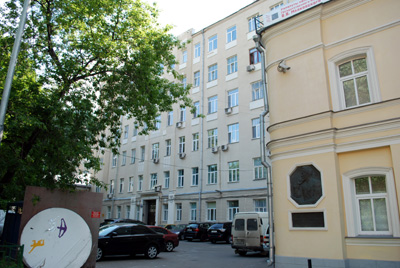
When Chekhov returned from his trip to Sakhalin Island in December 1890, he moved into an apartment behind this six-story building at Malaya Dmitrovka 29. It was very cramped quarters for his family, but they stayed there until 1892, when Chekhov finally realized his dream of having a place in the country and bought his small estate at Melikhovo about 50 miles outside of Moscow.

Posted in Homes and Museums | Tagged , , | Leave a comment

Levitan at the Tretyakov Gallery

Tretyakov1

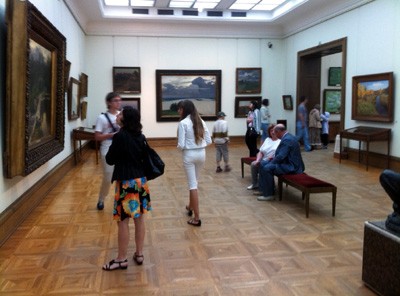
I decided to take a break from the archives and go see the Levitan paintings at the Tretyakov. In 1879 the business magnate and art patron Pavel Tretyakov paid 100 rubles for Levitan’s painting “Autumn Day, Sokolniki,” which he saw at a student exhibition. Levitan was only 19 years old, and Tretyakov would go on to buy over 20 more paintings by Levitan for as much as 3,000 rubles. “Autumn Day” depicts a wide path gently curving through Sokolniki Park, a favorite haunt for landscape art students on the outskirts of the city. His classmate Nikolai Chekhov, Anton’s brother, convinced Levitan that the painting was insufficiently expressive, that the path was waiting for someone to inhabit it. So he added a woman in a black dress walking pensively along the path.

Tretyakov2

I spent several hours in the Levitan Room making detailed notes on each painting—there are about 25 in the room. Having spent more than two years looking at reproductions, it was interesting to take note of what caught my eye when looking at the originals. One was the quality of light in them. Many of the paintings depict the “magic hour,” when the sun has already gone behind the trees or hills, creating long shadows where there is still direct light and a muted, pastel tone to the sky. I was also struck by reflective qualities of the water, often dark and opaque. The water is like a black mirror, murky yet still reflecting the sky and the nearby reeds or trees.

It’s very clear from his later pieces that Levitan was moving towards embracing Impressionist techniques. One late piece “Stormy Day” depicts a sky that is pure Van Gogh, although Levitan’s colors are darker, more muted. Had he lived (he died very young at 39), he would have evolved towards greater abstraction, already evident in the painting “The Last Rays of Sun” (1899)—village huts, a road, a gate, all painted in very flat blocks of varying sepia tones.

Posted in Homes and Museums | Tagged , , | 1 Comment

Levitan’s Studio

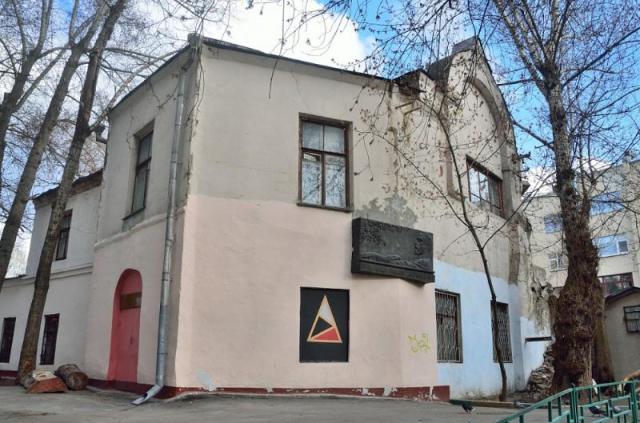
Levitan's home and studio

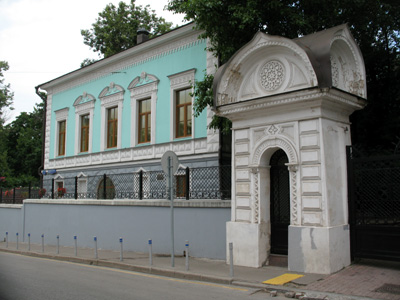
On Sunday I visited Levitan’s home and studio off Tryokhsvyatitelny (Three Prelates) Lane. In 1889 Sergei Morozov, a wealthy Moscow entrepreneur, gave Levitan the use of detached building next to his grand mansion located in a fashionable, secluded part of the city. The artist remained there until his death in 1900, living on the ground floor and working in his studio on the second floor.  The studio is in disrepair. In December 2020 the Ovcharenko Gallery purchased the building in an auction with the goal of restoring the structure and using it as an exhibition space.

Levitan Studio

Chekhov always felt distinctly uncomfortable with the milieu of Levitan’s wealthy benefactors. In 1897 when Chekhov had his first serious hemorrhage from tuberculosis, his doctors sent him to the south of Europe to recover. Levitan became deeply concerned about his friend’s health and well-being. Without consulting Chekhov, Levitan arranged for Morozov to lend Chekhov 2,000 rubles and send it to him in Biarritz. This exasperated Chekhov. He told Lika Mizinova: “I didn’t ask for this money; I don’t want it and I asked Levitan to allow me to return it in such a way, of course, that no one would get offended. Levitan doesn’t want this, but just the same I’m sending it back.” This led to a series of awkward exchanges, after which Levitan urged Chekhov to go see Morozov who was visiting Nice. Chekhov eventually did and told Levitan that he liked Morozov, but he might have been just trying to be polite. Levitan responded defensively: “He’s a good man, just too rich, that’s what’s bad, for him especially.”

Posted in Homes and Museums | Tagged , , | Leave a comment

The Lenin Library

Lenin Library Staircase

On Saturday I plunged into working at the Russian State Library. Getting into the library is a somewhat elaborate process: first, there is a checkpoint at which you scan your reader card, then you walk up to the checkroom to leave all your things, except a laptop and a notebook (no books are allowed, including Russian dictionaries); then you go through a second checkpoint where you are given a piece of paper on which all your transactions will be recorded and surrendered when you leave.

But it’s all worth it! Working in the Lenin Library is the most grand and elegant experience a Russian scholar can have. Foreigners are assigned to Reading Room #1, the same one reserved for Russian academics. Its windows look out onto the Kremlin palaces. When I was first here in the mid-1970’s one of my colleagues noticed that Vyacheslav Molotov, the old Bolshevik Minister of Foreign Affairs, now in his dotage, was sitting next to him in the reading room!

Reading Room #1

You submit your book requests to the lady in charge of Reading Room #1 and she tells you when they will be available for pickup, usually in an hour or so, so it’s best to bundle your requests. At the end of the day you can return them and have them held for you.

The holdings that are of interest to me are published materials related to Levitan from 1900-1917, written by people who knew Levitan when he was alive (he died in 1900). On the first day, I made notes on and translated portions of a 1902 monograph written by Solomon Vermel, a Jewish doctor, writer and acquaintance of Levitan. He argues that Levitan, despite being seen as the quintessential Russian landscape painter, was above all a Jewish artist, something not discussed much after the revolution. Vermel also wrote a memoir of the 1891-1892 expulsion of Jews from Moscow, which Levitan was swept up in—an unpublished document waiting for me in the archives later this week. I will also be looking at an article in a journal from the early 1900’s based on interviews with Levitan’s sister Teresa, who offers a rare glimpse into her brother’s impoverished childhood and youth, something Levitan never talked about to his friends.

Posted in Archives | Tagged | Leave a comment